

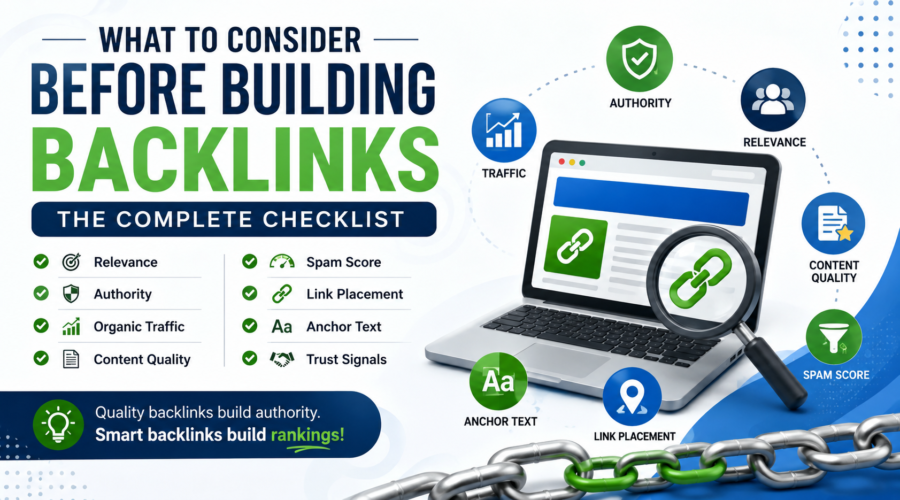
Backlinks remain one of the most powerful ranking factors in Google’s algorithm—but not all links are created equal. In fact, acquiring low-quality backlinks can do more harm than good, triggering algorithmic penalties or manual actions that tank your organic visibility.
If you’re considering building or buying backlinks in 2026, you need a systematic, data-driven approach to evaluate every opportunity. This comprehensive backlink quality checklist gives you exactly that: 14 essential criteria to assess before acquiring any link, plus actionable strategies to build a sustainable, penalty-proof link profile.
Whether you’re an SEO specialist, digital marketer, or business owner, this guide will help you invest your link-building budget wisely and achieve lasting organic growth. Let’s dive in.
💡 Pro Tip: Quality always beats quantity in modern SEO. A single contextual backlink from a relevant, high-traffic site can outperform 100+ low-quality directory links.
Why Backlink Quality Matters More Than Quantity in 2026
Google’s algorithms have evolved dramatically. With updates like Helpful Content, Core Web Vitals, and the March 2024 Spam Update, search engines now prioritize user experience, topical authority, and genuine editorial value over manipulative link schemes.
Here’s why quality trumps quantity:
- Algorithmic Penalties: Low-quality or spammy backlinks can trigger Google’s Penguin algorithm, causing significant ranking drops.
- Wasted Resources: Spending budget on irrelevant links yields minimal ROI compared to strategic, high-value placements.
- Brand Reputation: Association with spammy sites can damage your brand’s credibility with both users and search engines.
- Sustainable Growth: High-quality backlinks compound over time, driving consistent organic traffic and authority.
According to recent SEO studies, websites with backlinks from domains possessing strong topical relevance and organic traffic see 3.2x faster ranking improvements than those pursuing generic high-DA links.
The 14-Point Backlink Quality Checklist: Evaluate Every Link Opportunity
Use this actionable framework to audit any backlink opportunity before committing time or budget.
1. Niche Relevance: The Foundation of Topical Authority
Ask: Is the linking website topically related to my industry?
Search engines use backlinks as “votes of confidence.” When those votes come from thematically relevant sources, they carry significantly more weight.
✅ Strong Examples:
- A dental clinic earning a link from a healthcare publication
- A SaaS tool featured in a tech review blog
- A local bakery mentioned in a regional food guide
❌ Weak Examples:
- A finance blog linking to a gaming website
- Unrelated guest posts stuffed with commercial anchors
Why it matters: Google’s BERT and MUM algorithms understand context. Relevant backlinks strengthen your site’s topical cluster, signaling expertise to search engines.
🔍 Action Step: Use Ahrefs’ “Referring Domains” report or SEMrush’s “Backlink Analytics” to analyze the topical distribution of a potential linking site’s existing backlink profile.
2. Organic Traffic: Verify Real Audience Engagement
Ask: Does this website receive genuine, consistent organic traffic?
A domain with high metrics but zero traffic is a red flag. Real users = real value.
Tools to Check Traffic:
- Ahrefs Site Explorer
- SEMrush Traffic Analytics
- SimilarWeb
- Google Search Console (for your own properties)
Green Flags:
- Steady or growing organic traffic trends
- Ranking for relevant, non-branded keywords
- Recent content updates with engagement signals
Red Flags:
- Zero or declining organic traffic
- Traffic spikes from suspicious sources
- Ranking only for branded or low-volume terms
💡 Insight: A DA 25 site with 5,000 monthly organic visitors often delivers more SEO value than a DA 60 site with no traffic.
3. Indexing Status: Confirm Google Recognition
Ask: Is the linking domain properly indexed by Google?
If Google hasn’t indexed a site, its links likely won’t pass value.
Quick Check:
1
Enter this in Google Search. If few or no pages appear, investigate further.
Advanced Verification:
- Use Google Search Console’s URL Inspection tool
- Check the site’s robots.txt and meta robots tags
- Analyze crawl stats in Ahrefs or Screaming Frog
Sites with widespread indexing issues may have technical SEO problems or quality penalties—avoid linking from them.
4. Domain Authority Metrics: Use as Secondary Signals Only
Ask: Am I overvaluing DA/DR while ignoring real performance metrics?
Moz’s Domain Authority (DA) and Ahrefs’ Domain Rating (DR) are useful comparative tools—but they’re third-party metrics, not Google ranking factors.
Smart Approach:
- Use DA/DR to shortlist opportunities
- Prioritize traffic, relevance, and content quality for final decisions
- Compare metrics within your niche for context
⚠️ Warning: Many “high-DA” link sellers manipulate metrics. Always verify with organic traffic and content audits.
5. Spam Score: Protect Your Site from Toxic Associations
Ask: What is the linking site’s spam risk level?
Tools like Moz Spam Score or Ahrefs’ “Referring Domains” spam analysis help identify risky properties.
Spam Score Guidelines:
- 0–5%: Excellent—proceed with confidence
- 5–15%: Acceptable with manual review
- 15%+: Investigate thoroughly or avoid
High-Risk Signals:
- Excessive outbound links to casino, adult, or crypto sites
- Keyword-stuffed anchor text profiles
- Thin, auto-generated, or duplicated content
Avoid link networks, PBNs (Private Blog Networks), and sites selling links at scale—they violate Google’s Webmaster Guidelines.
6. Content Quality: Editorial Standards Matter
Ask: Would a real human find this content valuable?
Google prioritizes E-E-A-T (Experience, Expertise, Authoritativeness, Trustworthiness). Low-quality content undermines link value.
Evaluate For: ✅ Original research, data, or unique insights
✅ Proper grammar, formatting, and structure
✅ Clear author bios with credentials
✅ Regular content updates and engagement
Avoid: ❌ AI-generated spam with no human editing
❌ Thin articles under 300 words
❌ Keyword stuffing or unnatural phrasing
❌ Missing author information or contact details
🔍 Pro Tip: Read 3–5 recent articles from the site. If they feel generic or low-effort, the backlink likely is too.
7. Outbound Link Profile: Avoid Link Dilution
Ask: How many external links does this page contain?
Every outbound link shares the page’s “link equity.” Too many dilute value.
Best Practices:
- Prefer pages with <50 total outbound links
- Avoid “link farm” pages listing hundreds of resources
- Check if the site sells links openly (a Google violation)
Red Flag Example:
A blog post titled “Best SEO Tools” with 200+ affiliate links and no original analysis is likely a paid link page—proceed with caution.
8. Link Placement: Contextual > Peripheral
Ask: Where exactly will my link appear?
Not all placements deliver equal SEO value.
High-Value Placements:
- Editorial mentions within relevant article content
- Resource pages with curated, niche-specific tools
- Guest posts with natural, contextual anchors
Lower-Value Placements:
- Footer or sidebar links (often site-wide and devalued)
- Author bio links with generic anchors
- Comment section or forum signatures
💡 Data Point: Contextual in-content links pass up to 3x more ranking signal than footer links (Source: Moz Link Equity Study).
9. Anchor Text Diversity: Mimic Natural Linking Patterns
Ask: Does the anchor text appear organic and varied?
Over-optimized anchor profiles trigger spam filters.
Natural Anchor Distribution:
- 40–50% branded anchors (e.g., “SelenoSoft”)
- 20–30% generic/naked URLs (e.g., “click here,” https://…)
- 15–25% partial-match or topical phrases
- <10% exact-match commercial keywords
Avoid:
Using “best SEO services” as anchor text for every backlink. This pattern looks manipulative to Google’s algorithms.
10. Website Trust Signals: Verify Legitimacy
Ask: Does this site demonstrate transparency and credibility?
Trustworthy sites share clear business information.
Check For: ✅ Detailed “About Us” and “Contact” pages
✅ Privacy policy and terms of service
✅ Active social media profiles with engagement
✅ Author bios with verifiable credentials
✅ HTTPS security and professional design
Sites missing these elements may be low-effort link farms. When in doubt, skip the opportunity.
11. Link Velocity: Build Naturally, Not Aggressively
Ask: Am I acquiring links at a sustainable pace?
Sudden spikes in backlink acquisition look unnatural to Google.
Healthy Link Building:
- 5–15 new referring domains per month for small sites
- Gradual growth aligned with content publishing
- Mix of editorial, guest post, and organic mentions
Avoid: ❌ Buying 500 links in one week
❌ Using automated link-building software
❌ Participating in “link blasts” or bulk packages
📊 Case Study: A B2B SaaS company that grew backlinks by 12% monthly saw 210% organic traffic growth in 10 months—versus a competitor who bought 1,000 links overnight and received a manual penalty.
12. DoFollow vs. NoFollow: Balance Your Profile
Ask: Am I building a natural mix of link attributes?
Both link types have strategic value.
DoFollow Links:
- Pass PageRank and ranking signals
- Essential for authority building
NoFollow Links:
- Can drive referral traffic and brand exposure
- Contribute to a natural, diverse backlink profile
- Often appear in social media, forums, and press mentions
Ideal Ratio:
Aim for 70–80% DoFollow and 20–30% NoFollow links—a pattern that mirrors organic linking behavior.
13. Geographic Relevance: Critical for Local SEO
Ask: Does the linking site serve my target location?
For local businesses, geographic signals boost local pack rankings.
Examples:
- A Kerala-based clinic earning links from Malayalam health blogs
- A London law firm featured in UK legal directories
- A Toronto restaurant mentioned in local food guides
Action Steps:
- Target region-specific publications and directories
- Include location modifiers in anchor text naturally
- Ensure NAP (Name, Address, Phone) consistency across citations
🌍 Local SEO Tip: Google prioritizes locally relevant backlinks for “near me” searches. A link from a city-specific blog often outperforms a generic national site.
14. Manual Review Checklist: The Final Gut Check
Before acquiring any backlink, run this quick audit:
✓ Is the site topically relevant to my niche?
✓ Does it receive consistent organic traffic?
✓ Is it properly indexed by Google?
✓ Is the content original, well-written, and useful?
✓ Is the spam score below 15%?
✓ Would a real user find value in visiting this site?
✓ Is the link placed contextually within content?
If you answer “yes” to at least 5 of these 7 questions, the opportunity is likely worth pursuing.
How to Audit Backlinks Before Acquisition: A Step-by-Step Workflow
Follow this process to systematically evaluate link opportunities:
- Initial Screening
- Check domain metrics (DA/DR) and traffic estimates
- Verify indexing status via
site:search - Review homepage and recent content quality
- Deep Dive Analysis
- Analyze referring domains for spam patterns
- Evaluate outbound link density and anchor distribution
- Confirm trust signals (contact info, author bios, policies)
- Placement Verification
- Request exact URL and context for your link
- Ensure editorial relevance and natural anchor text
- Avoid site-wide or footer placements
- Post-Acquisition Monitoring
- Track indexing of the linking page
- Monitor referral traffic and ranking impact
- Disavow toxic links if quality declines
🛠️ Tool Stack Recommendation: Combine Ahrefs (backlink analysis), SEMrush (traffic data), and Google Search Console (indexing monitoring) for comprehensive audits.
Essential Tools for Backlink Quality Analysis
Equip your SEO toolkit with these industry-standard platforms:
| Tool | Best For | Key Feature |
|---|---|---|
| Ahrefs | Backlink profiling, traffic analysis | Site Explorer, Referring Domains report |
| SEMrush | Competitive research, keyword gaps | Backlink Audit tool, Traffic Analytics |
| Moz Pro | Spam score, domain authority | Link Explorer, Spam Score metric |
| SimilarWeb | Traffic source verification | Audience overlap, engagement metrics |
| Google Search Console | Indexing status, manual actions | URL Inspection, Links report |
Budget-Friendly Alternative: Use free tiers of Ubersuggest or SmallSEOTools for basic checks—but invest in premium tools for serious link building.
Common Backlink Scams to Avoid in 2026
Protect your site from these high-risk tactics:
❌ DA/DR Manipulation Services
Artificially inflated metrics that don’t reflect real authority.
❌ Redirect Chains & Cloaking
Links that pass through multiple domains to hide origins.
❌ Google URL Shorteners
Using google.com/url?q= links to mask destination URLs.
❌ PBN Networks
Private Blog Networks designed solely for link selling—easily detectable by Google.
❌ Auto-Generated Profile Links
Mass-created forum or comment links with commercial anchors.
❌ Bulk Directory Submissions
Low-quality directories with no editorial standards.
❌ “10,000 Backlinks for $50” Packages
Quantity-over-quality offers that violate Google guidelines.
⚠️ Google’s Stance: Any link intended to manipulate PageRank violates Webmaster Guidelines. Focus on earning links through valuable content and genuine relationships.
Building a Sustainable Link Building Strategy
Shift from transactional link buying to strategic authority building:
1. Create Link-Worthy Assets
Develop original research, comprehensive guides, or unique tools that naturally attract citations. Example: A data-driven industry report earns 3x more backlinks than generic blog posts.
2. Pursue Strategic Guest Posting
Target reputable sites in your niche with genuine audience overlap. Prioritize editorial value over link placement.
3. Leverage Digital PR
Pitch newsworthy stories to journalists and industry publications. Earned media links carry exceptional authority.
4. Fix Broken Links
Use tools like Ahrefs’ Broken Link Checker to find 404s on relevant sites. Offer your content as a replacement—a win-win outreach tactic.
5. Build Relationships, Not Just Links
Engage with influencers, bloggers, and journalists authentically. Long-term partnerships yield recurring link opportunities.
🌟 Success Framework: For every 10 hours spent on link building, allocate 7 hours to content creation and 3 hours to outreach. Quality content attracts links organically.
Frequently Asked Questions (FAQ)
Q: How many backlinks do I need to rank #1 on Google?
A: There’s no magic number. Focus on acquiring high-quality, relevant links from authoritative sites. One powerful backlink can outweigh dozens of weak ones.
Q: Is buying backlinks against Google’s guidelines?
A: Yes. Google explicitly prohibits buying or selling links that pass PageRank. Focus on earning links through valuable content and ethical outreach.
Q: How long does it take for backlinks to impact rankings?
A: Typically 4–12 weeks for Google to crawl, index, and weigh new backlinks. Consistent, quality link building yields compounding results over 6–12 months.
Q: Should I disavow low-quality backlinks?
A: Only if you have a manual penalty or suspect negative SEO. For most sites, Google’s algorithms automatically devalue spammy links. Consult an SEO expert before using the Disavow Tool.
Q: Can nofollow links help SEO?
A: Indirectly, yes. They drive referral traffic, increase brand visibility, and contribute to a natural backlink profile—all positive signals for SEO.
Conclusion: Prioritize Quality, Relevance, and Sustainability
In today’s SEO landscape, backlink quality isn’t just important—it’s non-negotiable. Google’s algorithms increasingly reward websites that earn links through genuine value, topical expertise, and user-focused content.
By applying this 14-point backlink quality checklist, you’ll:
- Avoid costly penalties from toxic links
- Maximize ROI on your link-building budget
- Build sustainable organic growth that compounds over time
Remember: The goal isn’t to collect the most backlinks—it’s to earn the right backlinks from sites that matter to your audience and your industry.
🚀 Ready to elevate your SEO strategy? Partner with experts who prioritize ethical, data-driven link building. Visit SelenoSoft for comprehensive SEO solutions that drive measurable, long-term results.
Final Pro Tip: Bookmark this checklist and review it before every link acquisition. Consistent quality control is the foundation of penalty-proof SEO success.
Disclaimer: This guide is for educational purposes. Always comply with Google’s Webmaster Guidelines when building backlinks.